Reversible vs Irreversible Decisions: The Two-Way Door Rule
Jeff Bezos' two-way door framework sorts decisions into reversible and irreversible. Amazon uses it to make faster, smarter choices by knowing which doors it can walk back through.
Most decisions are reversible, and treating them as permanent is the most common cause of costly, unnecessary overthinking. Jeff Bezos formalised the distinction in Amazon's 2015 shareholder letter. Type 1 decisions are irreversible and high-stakes, and they deserve slow, deliberate analysis. Type 2 decisions are easy to undo and should be made quickly with about 70% of the information you'd ideally want, because the cost of delay reliably exceeds the risk of a mistake you can fix.
You've been analysing a decision for three weeks. The data keeps piling up and the meetings keep multiplying, while competitors move and opportunities close. That's what happens when you apply Type 1 decision-making to a Type 2 problem, and it's one of the most expensive cognitive errors in business and in life.
What are reversible vs irreversible decisions?
Jeff Bezos divides all decisions into two categories, which he calls "one-way doors" and "two-way doors." He first described the framework in his 2015 Amazon shareholder letter, and it has since become one of the most cited decision-making frameworks in business.
One-way doors are irreversible decisions. Once you walk through, you can't easily come back. These are the big bets: selling your company, getting married, having kids, shutting down a division. Their consequences last, so they deserve careful analysis.
Two-way doors are reversible decisions. You can walk through, look around, and come back if you don't like what you see. Launching a new feature, trying a marketing channel, hiring someone, and changing your pricing can all be undone, so they should move fast.
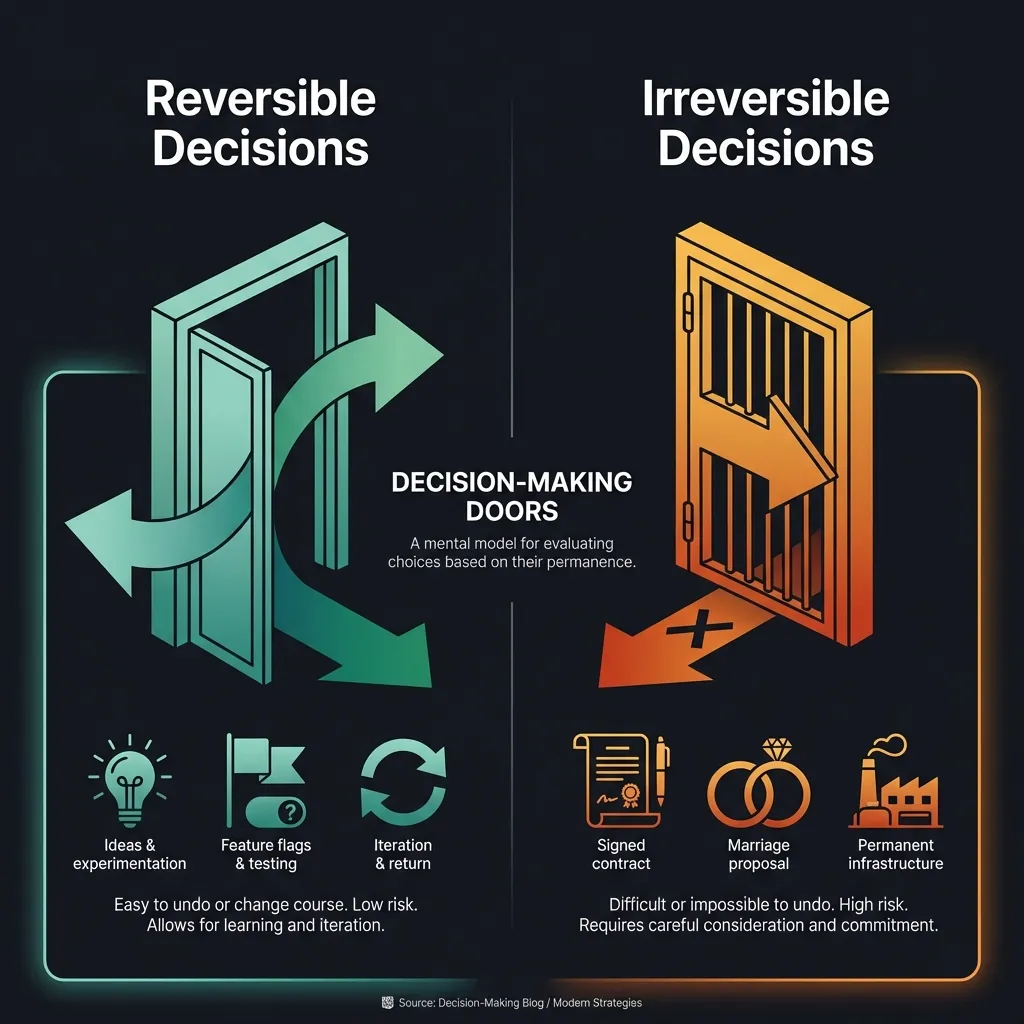
Most people get this backwards. They treat two-way doors like one-way doors and analyze reversible choices to death, while the truly irreversible decisions don't get enough scrutiny.
Bezos calls this "one-way door decision-making for two-way door decisions." It kills speed and leaves organizations bureaucratic and risk-averse.
Why the distinction matters
Amazon runs on this principle. Since most decisions are two-way doors, the company defaults to speed over perfection. "Disagree and commit" means moving forward without consensus, because when a decision is reversible, being wrong is cheap. The principle is one of Amazon's 16 official Leadership Principles and ties directly to the two-way door framework.
That's a big competitive advantage. While others are still in meetings, Amazon has already tested three approaches, and it knows what works because it tried it instead of analyzing it to death.
It only works if you correctly identify which decisions are reversible. Get it wrong and you move fast toward disaster. Get it right and you outmaneuver everyone while taking less risk. So the skill that matters is telling reversible decisions from irreversible ones before you make them.
How to identify one-way doors (irreversible decisions)
True one-way doors share certain features, and they're rarer than you think.
They involve significant sunk costs
Once money, time, or resources go in, you can't get them back. Building a factory, acquiring a company, or spending your savings on a business creates commitment you can't undo.
If a decision means spending resources you can't recover, it's probably irreversible and deserves slow, careful analysis.
They create legal or contractual obligations
Signing a 10-year lease, selling equity in your company, and getting married all involve binding agreements. Walking them back means legal processes, penalties, or permanent consequences.
Contracts make decisions sticky, so think them through completely before you sign.
They fundamentally change your identity or trajectory
Having children, getting a face tattoo, and dropping out of school reshape who you are or close off whole life paths. These go beyond hard to reverse; in practice they can't be reversed at all.
When a decision permanently changes you or removes future options, it's a one-way door. Treat it that way.
They involve other people's lives
Hiring is a two-way door, since you can part ways. Firing someone, though, affects their livelihood and family. Shutting down a division affects dozens of lives, and choosing a co-founder ties your success to theirs.
When other people's welfare depends on your choice, the decision carries one-way door weight and needs extra care.
How to identify two-way doors (reversible decisions)
Most decisions are more reversible than they feel. Your brain exaggerates permanence and makes mountains out of molehills, so you move too slowly.
The 30-day test
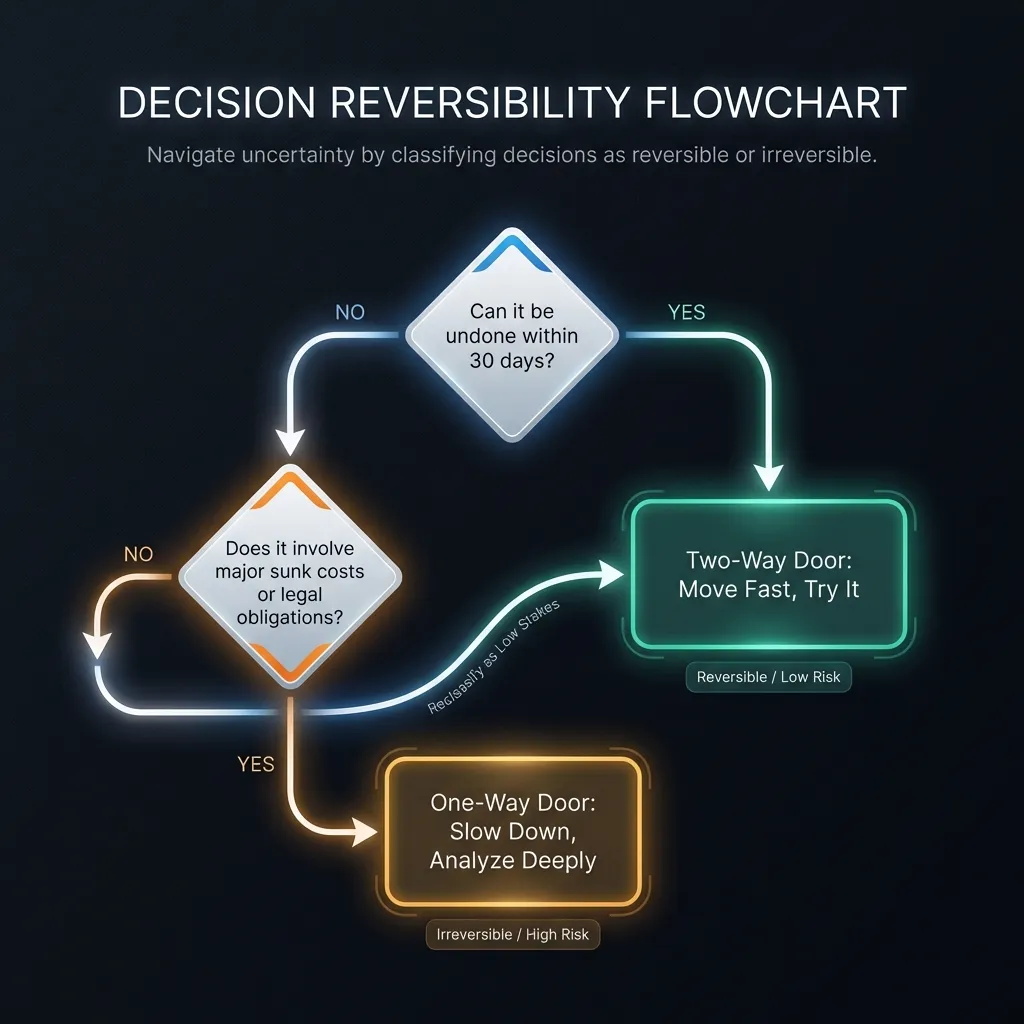
Ask: "If this goes badly, can I undo it within 30 days?" If yes, it's probably reversible.
You can kill a feature next month, revert a pricing change, and find out within a month whether a new process works.
If you can reverse course quickly, you're looking at a two-way door. Move fast, try it, and learn from reality instead of guessing.
The resource recovery test
Ask: "If I reverse this, what do I lose permanently?" If the answer is "not much," it's reversible.
Hiring someone costs time and money, but if they don't work out, you part ways. The cost is real but limited. You can't "un-sell" a company in the same way.
Two-way doors have limited downside, so the cost of being wrong stays manageable.
The learning value test
Ask: "Even if this fails, will I learn something useful?" If yes, the failure itself creates value and the decision is lower risk.
Most experiments are two-way doors because failure teaches you something. Even "wrong" choices give you data, which makes them cheaper than they look.
The big mistake: treating two-way doors like one-way doors
This is how organizations get slow and bureaucratic. Every decision needs six meetings, three layers of approval, and a 40-page deck, and teams spend months analyzing reversible choices.
Fear drives it. Nobody wants to make a mistake, especially one they'll be blamed for, so analysis becomes protection. "We studied it thoroughly" sounds better than "we moved fast and learned."
The hidden costs are large. While you analyze, competitors test, learn, and iterate, and you're still trying to predict the future from a conference room.
For reversible decisions, speed matters more than perfection. Getting it 70% right today beats getting it 95% right in six months, especially when you can correct course along the way.
How Amazon uses the two-way door framework
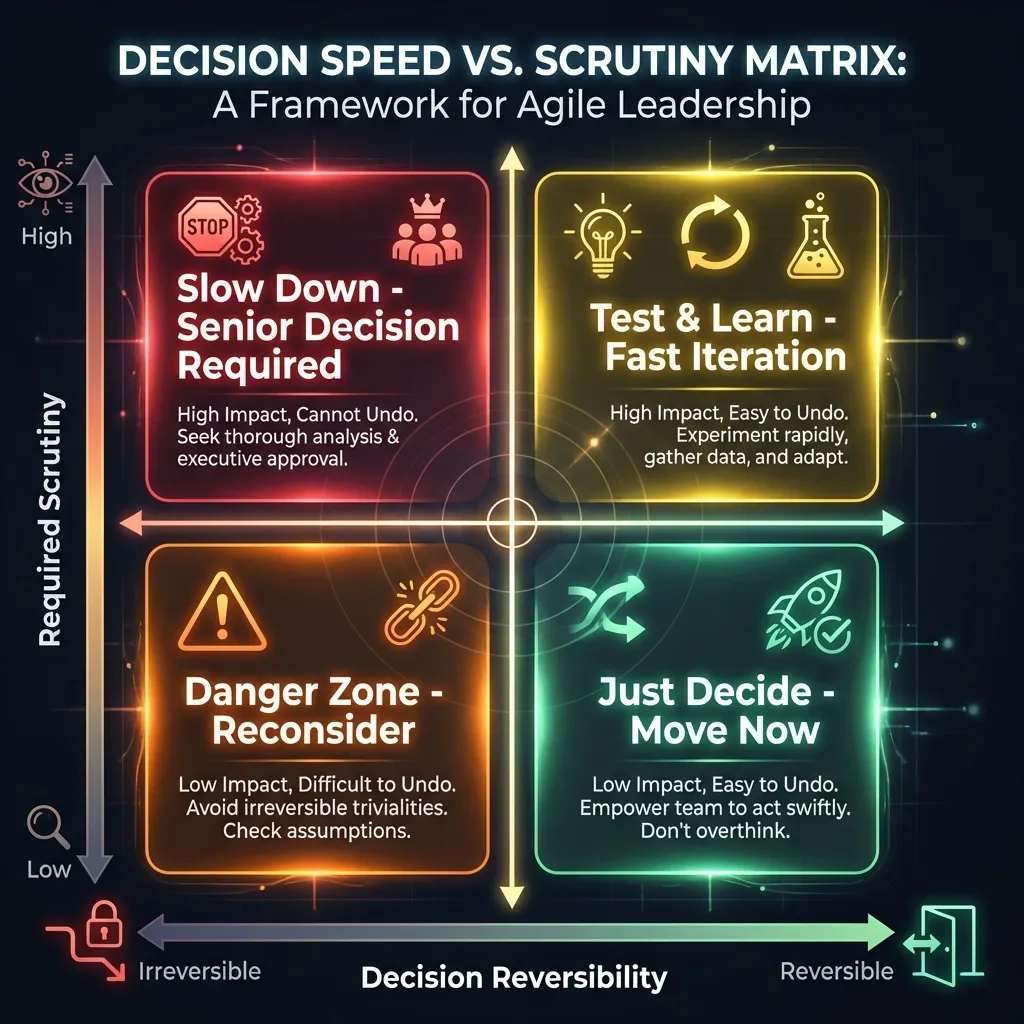
At Amazon, teams explicitly label decisions by asking, "Is this a one-way or two-way door?" The question comes up constantly, and the answer determines the process.
Two-way doors: a small team decides, moves fast, tries it, and iterates based on results.
One-way doors: senior leadership gets involved, the team gathers more data, debates thoroughly, and makes sure it's right.
The result is a culture of intelligent speed. Teams move quickly on most things because most things are reversible, and slow down for the few choices that really matter.
The framework changes the psychology too. Knowing you can reverse course removes fear, so people are more willing to experiment, which drives innovation.
Examples of reversible vs irreversible decisions
Startup scenarios
Two-way door: testing a new pricing model. Launch it, watch what happens, and revert if conversion tanks.
One-way door: raising venture capital. Once you take VC money, you've committed to specific growth expectations and exit timelines, and your business changes fundamentally.
Career decisions
Two-way door: taking a job at a new company. If you don't like it, you can leave within a year. People switch jobs all the time.
One-way door: starting your own company. The gap on your resume, the financial risk, and the opportunity cost make it much harder to reverse.
Relationship decisions
Two-way door: dating someone, going exclusive, even moving in together. These can be undone if they aren't working.
One-way door: getting married, especially with kids. The legal, financial, and emotional complexity makes it functionally irreversible. Even divorce doesn't truly return you to where you started.
Product development
Two-way door: adding a new feature. You can always remove it later. Users might complain, but it's fixable.
One-way door: switching your entire tech stack, migrating platforms, or changing your core architecture. These take massive effort and can't easily be undone.
How to decide faster on two-way doors
Once you've identified a two-way door, change your process completely.
Set a decision deadline
Give two-way doors 48 hours of analysis at most, maybe less. Set a timer, make the call, and move on.
If you can reverse it, overthinking gains you nothing. Speed is worth more than small gains in accuracy, so decide quickly and learn from reality.
The 10-10-10 rule is a useful companion for breaking deadlock: it asks how you'll feel about the choice in 10 minutes, 10 months, and 10 years. For two-way doors, the 10-minute anxiety usually disappears by the 10-month frame, which is the signal you need to move.
Use "disagree and commit"
Don't wait for consensus on reversible decisions. If someone disagrees, acknowledge it, then commit to trying one approach. Agree in advance on how you'll measure success and when you'll revisit.
That ends the endless debate that kills momentum. You might be wrong, and that's fine, because you can fix it.
Build in review points
Instead of trying to make the perfect decision up front, plan to review it: "We'll try this for 30 days, then evaluate."
That takes the pressure off. You're running a test with an end date, so the decision becomes easier to make quickly.
Accept "good enough"
For two-way doors, 70% confidence is enough. You don't need 95% certainty, and the remaining 25% isn't worth the time.
Make the call with incomplete information, learn from what happens, and adjust. That beats trying to analyze your way to certainty.
How to decide better on one-way doors
One-way doors need different treatment: slow down, think deeply, and involve more people.
Use the regret minimization framework
Imagine yourself at 80 looking back, and ask which choice you'd regret less. That long view helps you see past immediate emotions, which is what one-way doors require. Bezos used exactly this approach when deciding to leave a six-figure Wall Street job to start Amazon. Our 10-10-10 Rule tool walks you through a similar long-view check.
Look for disconfirming evidence
Don't just look for reasons to go ahead. Actively hunt for reasons to back away. What could go wrong? Which assumptions might be false?
Being wrong about an irreversible decision is expensive, so try harder to prove yourself wrong before committing. Research from cognitive psychology consistently shows that actively seeking disconfirming information greatly improves the quality of high-stakes decisions.
This is also the time to check whether the urgency you feel is real. Anchoring, artificial scarcity, and reciprocity are among the psychological tricks that actually work on people facing a one-way door. An opening number or a closing "window" can make an irreversible decision feel more time-pressured than it is.
Run a pre-mortem
Assume the decision failed spectacularly and ask why. List every possible reason, then address those risks before going ahead.
This is the pre-mortem technique, an application of inversion. It exposes blind spots that enthusiasm hides, so you make irreversible choices with your eyes open. It works especially well before one-way door decisions because it makes you consider ways back before you're locked in.
Give it time
Sleep on one-way doors. Take a week, or a month. Let the initial excitement fade and see whether the decision still makes sense once your emotions settle.
The hidden third category: making irreversible decisions more reversible
Sometimes you can redesign a choice to make it more reversible, which is often smarter than accepting permanence.
Instead of hiring someone full-time, which is harder to reverse, start with a contract, test the relationship, and convert to full-time if it works.
Instead of committing to a 10-year lease, negotiate a 3-year lease with renewal options. You're buying reversibility.
Instead of launching everything at once, phase the rollout. Each phase is reversible, and full commitment comes only after validation.
Ask how you could make the decision more reversible. There's often a way, and finding it cuts risk dramatically. This is the third option most decision-makers overlook, and the subject of our guide to escaping false dilemmas.
Your action plan this week
Take a decision you're facing right now and ask:
Is this reversible or irreversible?
If it's a two-way door, stop analyzing. Set a 48-hour deadline, make the call, test it, and learn from reality.
If it's a one-way door, slow down. Run a pre-mortem, look for disconfirming evidence, sleep on it, and make sure you're ready to commit.
Above all, notice your own tendency. Do you treat two-way doors like one-way doors? It's the most common mistake, and it costs you speed without reducing risk.
Conclusion
The distinction between reversible and irreversible decisions sounds simple: walk through some doors and stay away from others. Applying it consistently changes how you operate.
You stop treating every choice like a permanent commitment, so you move faster, test more, and learn sooner, while staying appropriately careful about the choices that really matter.
That's how Amazon built a culture of innovation while managing risk: it knew which decisions deserved speed and which deserved scrutiny.
Start asking "Is this a one-way or two-way door?" today. The answer tells you how fast to move.
Frequently Asked Questions
What are reversible vs irreversible decisions?
Reversible decisions (two-way doors) can be undone with minimal cost. Irreversible decisions (one-way doors) have lasting consequences that can't be easily reversed. Jeff Bezos uses this framework at Amazon to determine how fast to make decisions.
What is the two-way door framework?
The two-way door framework, created by Jeff Bezos, categorizes decisions as either one-way or two-way doors. Two-way doors are reversible and should be made quickly. One-way doors are irreversible and deserve careful analysis.
How do you know if a decision is irreversible?
A decision is likely irreversible if it involves significant unrecoverable costs, creates legal obligations, fundamentally changes your identity or trajectory, or significantly impacts other people's lives. If you can't undo it within 30 days without major consequences, treat it as a one-way door.
How does Amazon use this framework in practice?
Amazon teams explicitly ask "Is this a one-way or two-way door?" before any major decision. Two-way doors are handled by small teams moving fast. One-way doors escalate to senior leadership for deeper analysis. This approach is embedded in Amazon's Leadership Principles.
Sources
- Bezos, J. (2016). 2015 Annual Letter to Shareholders. Amazon.com, Inc. Original articulation of Type 1 (irreversible) vs. Type 2 (reversible, two-way door) decisions.
- Gilbert, D. T., Morewedge, C. K., Risen, J. L., & Wilson, T. D. (2004). Looking forward to looking backward: The misprediction of regret. Psychological Science, 15(5), 346–350. https://doi.org/10.1111/j.0956-7976.2004.00681.x. People overestimate regret from reversible decisions.
- Gilovich, T., & Medvec, V. H. (1995). The experience of regret: What, when, and why. Psychological Review, 102(2), 379–395. https://doi.org/10.1037/0033-295X.102.2.379. Long-run regret favours inaction; short-run regret favours action.
- Kahneman, D. (2011). Thinking, Fast and Slow. Farrar, Straus and Giroux. Loss aversion and the asymmetric weight of potential losses vs. gains.
- Klein, G. (1998). Sources of Power: How People Make Decisions. MIT Press. Recognition-primed decision model; fast decisions in high-stakes domains.
Try This Next
Continue Reading
All ArticlesThe 70% Rule: How to Cure Analysis Paralysis and Make Faster Decisions
Jeff Bezos built Amazon on a simple doctrine: decide with 70% of the information you wish you had. Waiting for certainty is itself a choice, and often the worst one.
The One Thinking Habit That Separates the Top 1% from Everyone Else
Most people think one step ahead. The people who keep winning in business, investing, and life think two. Second-order thinking is the skill behind Jeff Bezos's long-termism, Howard Marks's investor letters, and every decision that looks obvious in hindsight. Here's how it works and how to make it automatic.
Flipping a Coin: The Surprising Science of Decision Making
Stuck between two equally good choices? Flipping a coin can be the most rational tool for the job, because it reveals what your subconscious already knows.